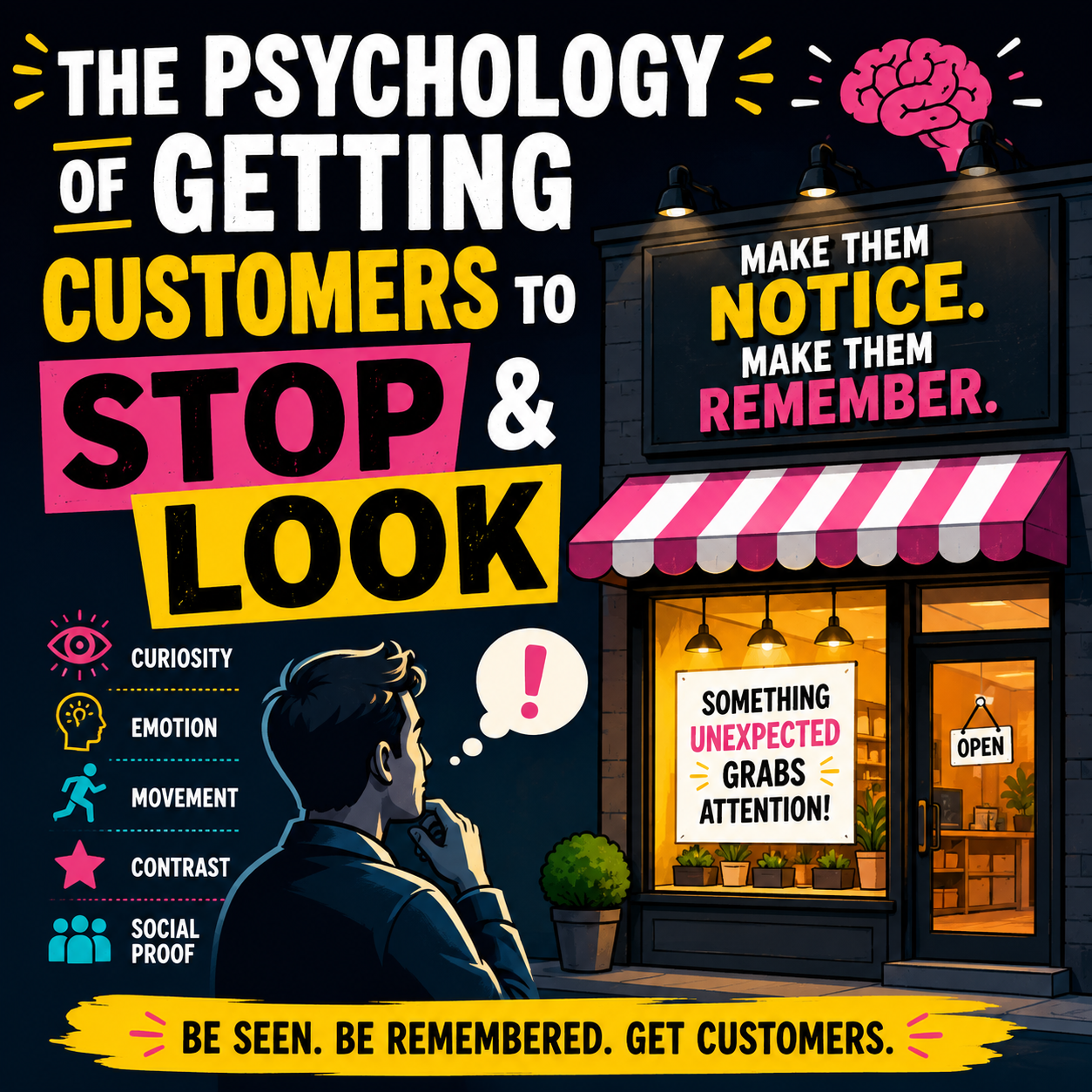
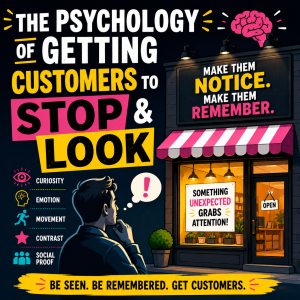
The Psychology of Getting Customers to Stop and Look
Have you ever been walking through a store, scrolling through your phone, or wandering around a trade show when something suddenly made you stop?
Maybe it was a bright display.
Maybe something moved.
Maybe you saw something unusual and thought:
“Wait…what is that?”
For a moment, whatever you were doing became less important. Something grabbed your attention.
For a business owner, that moment is incredibly valuable.
Before someone can become interested in your product, walk into your store, read your promotion, or consider making a purchase, something has to happen first:
They have to notice you.
That’s why understanding the psychology behind getting customers to stop and look can completely change the way you think about marketing.
And don’t worry—we’re not going to turn this into a psychology textbook.
The basic idea is actually pretty simple.
Why Getting Customers to Stop and Look Is Harder Than Ever
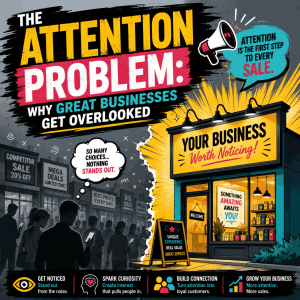
Your customers are surrounded by messages.
Think about everything competing for their attention during an average day:
- Phone notifications
- Emails
- Social media
- Advertisements
- Store signs
- Billboards
- Videos
- Text messages
- Product packaging
- Conversations
- Music
- Traffic
- Other people
That’s a lot for one brain to process.
So, naturally, our brains become very good at ignoring things.
In fact, that’s part of the problem businesses face.
Your customers aren’t necessarily choosing to ignore your sign, display, advertisement, or product.
They may barely notice it exists.
Therefore, getting customers to stop and look starts with giving their brains a reason to interrupt what they’re already doing.
Getting Customers to Stop and Look Starts With Pattern Interrupts
People love patterns.
We get used to seeing the same things over and over.
However, when something suddenly breaks the pattern, our attention naturally shifts toward it.
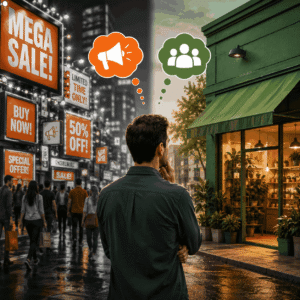
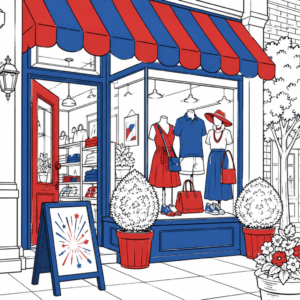
Imagine walking past ten stores.
Nine have ordinary window displays.
The tenth has something moving, changing, flashing, floating, spinning, or otherwise looking completely different.
Where are your eyes likely to go?
Probably toward the unusual one.
That’s called a pattern interrupt.
Fortunately, businesses can create pattern interrupts in many ways:
- Movement
- Unexpected colors
- Unusual displays
- Humor
- Surprising messages
- Interesting lighting
- Product demonstrations
- Unexpected sounds
- Creative signs
- Interactive experiences
You don’t necessarily need all of these.
Sometimes one unexpected element is enough.
Curiosity Is an Attention Magnet
One of the strongest tools for getting customers to stop and look is curiosity.
Humans naturally want answers.
When we see something we don’t immediately understand, our brain often wants to figure it out.
That’s why a little mystery can sometimes be more powerful than explaining everything immediately.
For example, imagine a sign that says:
“50% OFF SELECT ITEMS.”
That’s clear.
But now imagine one that says:
“Want to See What Everyone Keeps Asking About?”
Suddenly there’s a question in your mind.
“What are people asking about?”
That little unanswered question can create curiosity.
And curiosity creates attention.
Don’t Tell Them Everything at Once
Business owners sometimes try to squeeze their entire sales presentation into the first message.
The result looks something like this:
WE HAVE THE BEST PRODUCTS AT THE BEST PRICES WITH AMAZING CUSTOMER SERVICE AND FREE THIS AND DISCOUNTED THAT AND COME INSIDE TODAY BECAUSE…
Whoa.
That’s a lot.
Instead, think of your marketing as a series of small steps.
Your first message doesn’t always need to make the sale.
Sometimes its only job is to get the next three seconds of attention.
For example:
- Get them to look.
- Get them curious.
- Give them a reason to learn more.
- Show them the benefit.
- Present the offer.
- Ask them to take action.
Suddenly, marketing becomes much simpler.
Movement Naturally Attracts Attention
Our brains are very sensitive to movement.
There’s a good reason for that.
For most of human history, movement could mean something important was happening nearby.
Even today, movement naturally attracts our eyes.
Think about what happens when something moves in your peripheral vision.
You often look toward it without consciously deciding to.
That’s why movement can be especially useful for:
- Storefront displays
- Product displays
- Trade show booths
- Restaurants
- Event displays
- Digital signage
- Window displays
- Retail counters
However, there’s an important distinction.
Movement should attract attention to something useful.
Movement simply for the sake of movement can become distracting.
The goal isn’t:
“LOOK AT ALL THIS CRAZY STUFF!”
The goal is:
“Hey, look over here. There’s something interesting you might want to see.”
Getting Customers to Stop and Look With Contrast
Another powerful attention trigger is contrast.
Something stands out because it looks different from what’s around it.
For example:
- Bright against dark
- Large against small
- Moving against stationary
- Simple against cluttered
- Colorful against plain
- Unexpected against familiar
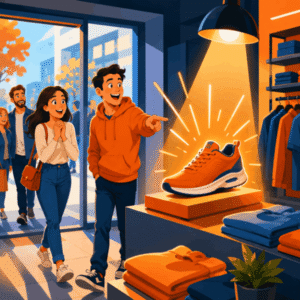
Suppose you have a shelf filled with 50 similar products.
If they’re all displayed the same way, your customer’s eyes may simply scan across everything.
However, if one product is elevated, illuminated, separated, or presented differently, suddenly it becomes more noticeable.
Difference creates attention.
Therefore, if you want customers to notice something, don’t automatically add more.
Sometimes you need to create contrast around what matters.
Simplicity Can Actually Get More Attention
This might sound strange, but sometimes the best way to stand out in a visually noisy environment is to become simpler.
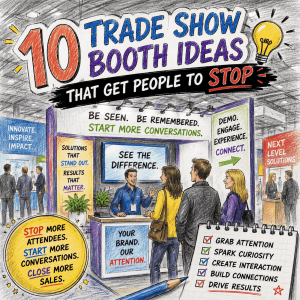
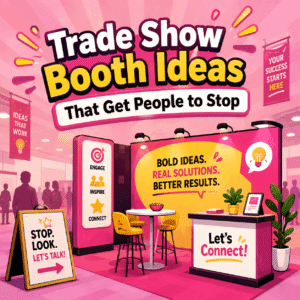
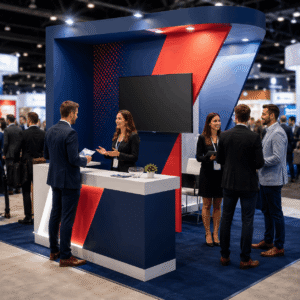
Imagine a trade show.
Every booth has:
- Banners
- Screens
- Posters
- Brochures
- Product displays
- Salespeople
- Giveaways
- Flashing graphics
Now imagine one booth with a huge simple message:
“STOP HERE.”
You’d probably notice it.
Why?
Because simplicity itself can create contrast.
The same principle applies to storefronts and advertisements.
Instead of giving customers 12 things to look at, decide what you want them to notice first.
Then build around that.
People Notice Other People
Humans are social.
We naturally pay attention to what other people are doing.
If you walk past a restaurant and see nobody inside, you might keep walking.
However, if you see a crowd gathered around something, you may wonder:
“What’s going on over there?”
That’s social proof at work.
Businesses can use this naturally.
For example:
- Show customer testimonials.
- Feature your most popular product.
- Label something a “Customer Favorite.”
- Show real customers interacting with your business.
- Highlight bestsellers.
- Encourage customers to share photos.
- Demonstrate products where others can see them.
When people notice other people paying attention, they often become curious themselves.
Attention can attract more attention.
Give Customers Something Unexpected
Predictability is comfortable.
But predictable things are also easy to ignore.
Imagine seeing a normal coffee shop sign:
“Coffee — $3.99.”
Nothing wrong with it.
Now imagine:
“WARNING: Our Coffee May Cause Unreasonable Productivity.”
You might smile.
More importantly, you might actually read it.
Humor is one example of the unexpected.
You can also create surprise through:
- Creative displays
- Unusual headlines
- Clever product names
- Unexpected demonstrations
- Fun employee interactions
- Interesting packaging
- Eye-catching visuals
- Interactive displays
The goal isn’t to be strange just to be strange.
The goal is to avoid becoming invisible.
Getting Customers to Stop and Look at Your Best Products
Here’s where all of this becomes especially valuable.
You probably have certain products or services you wish customers noticed more often.
Maybe they’re:
- High-margin products
- New arrivals
- Seasonal specials
- Add-on purchases
- Limited-time offers
- Bestsellers
- Products customers don’t understand yet
Don’t assume customers will find them.
Direct their attention.
Create a visual hierarchy.
Ask yourself:
“If someone looked at this area for only three seconds, what would they notice first?”
If the answer isn’t your most important product or message, consider changing the display.
The Three-Second Test
Here’s a simple experiment you can try today.
Stand outside your store, booth, restaurant, display, or sales area.
Pretend you’ve never seen it before.
Give yourself about three seconds.
Then ask:
- What did I notice first?
- What did I notice second?
- Was the most important message obvious?
- Was anything confusing?
- Was there something that made me curious?
- Would I want to look closer?
Better yet, ask someone unfamiliar with your business to do the same thing.
Don’t explain anything first.
Just ask:
“What do you notice?”
Their answer could teach you a lot.
Don’t Confuse Attention With Annoyance
There’s an important difference between attracting attention and demanding it.
Yes, flashing lights, loud noises, and aggressive messaging can get attention.
But that doesn’t mean it’s good attention.
You want customers thinking:
“That’s interesting.”
Not:
“How do I get away from this?”
So when you’re working on getting customers to stop and look, remember that attention should lead somewhere positive.
Good attention creates:
- Curiosity
- Interest
- Excitement
- Surprise
- Conversation
- Engagement
Bad attention creates:
- Irritation
- Confusion
- Discomfort
- Distrust
Your goal isn’t simply to interrupt.
It’s to interrupt and then reward the customer for paying attention.
Once You Have Their Attention, Don’t Waste It
Getting someone to look is only step one.
Once they’re looking, you need to give them a reason to keep looking.
That’s where your message comes in.
After capturing attention, quickly answer questions such as:
- What is this?
- Why should I care?
- What’s interesting about it?
- What’s in it for me?
- What should I do next?
Think of attention as opening a door.
Once the door opens, your offer needs to walk through it.
Attention Comes Before the Sale
Businesses spend enormous amounts of time thinking about:
- Pricing
- Promotions
- Discounts
- Offers
- Sales scripts
- Websites
- Advertising
- Products
Those things absolutely matter.
However, none of them work very well if nobody notices them.
That’s why the psychology of getting customers to stop and look matters so much.
The marketing process really starts before the sales pitch.
It starts with attention.
Attention leads to curiosity.
Curiosity leads to interest.
Interest creates the opportunity for action.
And action can eventually become a sale.
Try One Attention Experiment This Week
You don’t need to completely redesign your business.
Instead, choose one thing customers currently overlook.
Maybe it’s:
- A storefront promotion
- A restaurant special
- A high-margin product
- A trade show booth
- A new service
- A window display
- A checkout-area product
Then experiment with one attention trigger.
Try:
- Adding movement.
- Creating stronger contrast.
- Simplifying the message.
- Using a curiosity-based headline.
- Moving the product somewhere unexpected.
- Adding humor.
- Creating an interactive element.
- Highlighting what other customers love.
Then watch.
Do more people look?
Do they stop?
Do they ask questions?
Do they interact?
Most importantly, do they buy?
Your customers’ behavior will tell you what works.
Before Customers Buy, They Have to Notice
You don’t necessarily need a bigger advertising budget.
You don’t always need a bigger sign.
And you certainly don’t need to shout louder than every competitor around you.
Sometimes, you simply need to understand what naturally makes people stop, look, and become curious.
That’s the real power behind getting customers to stop and look.
Because before someone walks into your business…
Before they ask about your product…
Before they read your promotion…
Before they consider your offer…
And before they become a customer…
You have to win their attention.
Ready to Turn More Glances Into Customers?
At Biz Attention, we believe getting noticed is the first step toward getting more business.
That’s why we’re focused on creative ways to help businesses attract attention—from practical marketing ideas and customer psychology to attention-grabbing visual display solutions that can make people stop and take a second look.
Whether you’re trying to attract people from the street, highlight an overlooked product, promote a restaurant special, or stop traffic at a trade show, it all starts with the same question:
How are you going to get them to look?
👉 Discover how Biz Attention can help your business stop blending in and start getting noticed.











Leave a Reply