

How to Make Products on Your Shelves Get Noticed
You know that feeling when you walk through your store and realize something?
You have great products sitting right there on your shelves, but customers barely seem to notice them.
Maybe it’s a new product you’ve been excited about.
Maybe it’s something customers have been asking for.
Or perhaps it’s a product with excellent profit margins that simply isn’t moving.
And yet…
It’s just sitting there.
That’s frustrating.
After all, you can’t sell a product if customers don’t see it. And you certainly can’t expect them to get excited about something they barely notice.
The good news is that you don’t necessarily need more products.
Instead, you may need to change the way customers see the products you already have.
In this article, we’ll look at practical ways to make products on your shelves get noticed, create curiosity, and give customers a reason to stop and take a closer look.
Because ultimately, the goal isn’t to make your store louder.
It’s to make the right products harder to ignore.
Why Great Products Sometimes Get Ignored
Let’s start with something important.
Your customers aren’t necessarily ignoring your products because they don’t want them.
They may simply not be seeing them.
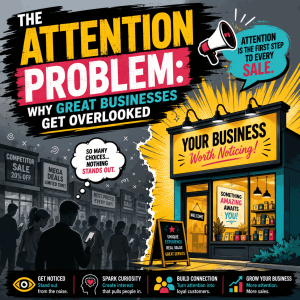
Think about everything competing for a customer’s attention when they walk into a store:
- Shelves
- Signs
- Price tags
- Product packaging
- Displays
- Promotions
- Employees
- Music
- Their phones
- Their shopping lists
- Everything else around them
That’s a lot of information.
As a result, customers quickly learn to tune out things that look ordinary.
In other words, a product can be sitting directly in front of someone and still become almost invisible.
That’s why learning how to make products on your shelves get noticed can be so valuable.
The first step isn’t always changing the product.
Sometimes, you simply need to change the experience around it.
1. Put Your Best Products in the Spotlight
First, take a look at where you’re putting the products you most want to sell.
Are they:
- Buried between dozens of other products?
- Sitting on the bottom shelf?
- Surrounded by competing products?
- Difficult to see from the aisle?
- Missing any explanation of why they’re worth noticing?
If so, you’re making customers work too hard to find them.
Instead, give your featured products some breathing room.
Simple Shelf Labels Can Help
Consider creating a small featured area with a message such as:
NEW ARRIVAL
CUSTOMER FAVORITE
STAFF PICK
JUST IN
TRY SOMETHING NEW
These simple messages immediately tell customers:
“Look here.”
And that’s exactly what you want.
Try This Today
Choose one product you’d really like to sell more of this week.
Then:
- Move it somewhere more visible.
- Give it some space.
- Add a short message explaining why it’s worth noticing.
- Watch how customers respond.
You may be surprised by how much difference a small change can make.
2. Don’t Make Everything Compete for Attention
Here’s an interesting problem many businesses have:
They try to make everything stand out.
Unfortunately, when everything is competing for attention, nothing really stands out.
Imagine walking into a store where every shelf has bright signs, large graphics, promotions, and multiple messages.
Where do you look?
Probably nowhere for very long.
Instead, create a visual hierarchy.
In other words, decide what you want customers to notice:
First.
Second.
Third.
For example:
- Featured product
- Reason to care
- Price or next step
This makes the shopping experience easier.
More importantly, it gives your featured product a better chance of being noticed.
So, if you’re trying to make products on your shelves get noticed, don’t automatically add more signs.
Sometimes, removing distractions works even better.
3. Use Contrast to Draw the Eye
Color can also help direct attention.
For example, imagine a shelf filled with products that all have similar colors and packaging.
Now imagine placing one featured product in a visually contrasting display.
Your eye naturally moves toward the difference.
That’s why retailers often use contrasting colors for:
- New products
- Sale signs
- Limited-time offers
- Featured products
- Special promotions
- Seasonal displays
However, you don’t need to turn your store into a rainbow.
In fact, a clean display can make the featured product even more noticeable.
The Simple Rule
Use contrast to create focus.
If everything looks the same, nothing gets priority.
On the other hand, if one product looks different for a reason, customers are more likely to notice it.
4. Put Products Where Customers Naturally Look
Next, think about shelf placement.
There’s a reason retailers pay so much attention to where products are positioned.
Customers don’t look at every part of every shelf equally.
Instead, certain areas naturally receive more attention.
Therefore, if you have a product you really want people to notice, don’t automatically put it wherever there’s an empty space.
Think strategically.
Consider Featuring:
- New products in highly visible positions
- Best sellers near the front
- Higher-margin products in prominent locations
- Impulse products near checkout
- Seasonal products where customers naturally pass
Of course, the best placement depends on your particular store.
Nevertheless, the basic idea is simple:
Make your customers’ natural shopping behavior work for you.
5. Give Customers a Reason to Care
A product sitting on a shelf has to compete with everything around it.
Therefore, sometimes the product itself isn’t enough.
Customers need a reason to pay attention.
That’s where a short message can help.
Instead of:
NEW PRODUCT
Try something more useful:
THE EASIEST WAY TO…
PERFECT FOR…
CUSTOMERS LOVE THIS BECAUSE…
TRY THIS IF YOU LIKE…
Now you’re giving customers context.
And context matters.
Customers don’t necessarily want to study every product on your shelves.
They want to quickly understand:
“Why should I care about this?”
So, if you want to make products on your shelves get noticed, don’t just show the product.
Give customers a reason to notice it.
6. Make Your Shelf Displays Move
Now let’s talk about something people naturally notice:
Movement.
Think about what happens when something moves in the corner of your eye.
You look.
It’s almost automatic.
That’s one reason video displays, animated signs, digital screens, and interactive displays can attract attention in retail environments.
A static product can blend into a shelf.
However, movement can interrupt the visual pattern.
Suddenly, someone looks.
And once they look, you’ve created an opportunity.
Picture the Scene
A customer walks past a shelf filled with products.
They’ve probably seen the same shelf dozens of times.
Then something unusual catches their eye.
They stop.
They look again.
They move closer.
Now they’re paying attention.
That’s the moment you’re trying to create.
You don’t necessarily need to convince them to buy immediately.
First, you just need to get them to look.
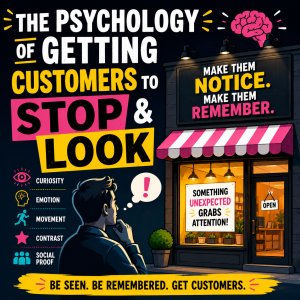
7. Create a “What’s That?” Moment
One of the best ways to get someone interested in a product is to create curiosity.
You’ve probably experienced this yourself.
You see something unusual and immediately think:
“What’s that?”
That’s a powerful reaction.
Because now you’re no longer ignoring the product.
You’re investigating it.
You Could Create Curiosity With:
- An unusual product presentation
- A short demonstration
- An unexpected visual
- An intriguing question
- A special display
- A product being shown in use
Whatever you choose, the goal is the same:
Give customers a reason to investigate.
And once they’re investigating, you have their attention.
8. Show the Product Instead of Just Showing the Package
Here’s another simple idea:
Show the product doing something.
A product sitting on a shelf is passive.
A demonstration is active.
For example:
- Selling a kitchen gadget? Show it being used.
- Selling electronics? Demonstrate what it can do.
- Selling beauty products? Show how they’re applied.
- Selling technology? Let customers interact with it.
- Selling something unusual? Give customers a quick demonstration.
The more customers can see the benefit, the easier it becomes for them to understand the product.
And when people understand something quickly, they’re often more comfortable considering it.
Try This
Choose one product that customers frequently ask about.
Instead of simply displaying it, find a way to demonstrate one thing it does particularly well.
Show them the answer instead of simply telling them.
9. Change What You Feature
Another easy way to make products on your shelves get noticed is to regularly change what you’re featuring.
Why?
Because people get used to seeing the same thing.
Think about your own home.
After a while, you stop noticing the pictures on your walls.
You stop noticing the furniture.
You stop noticing the decorations.
They’re still there.
But your brain has learned that they’re not new.
The same thing can happen in your store.
So, rotate your featured products.
For Example:
Week 1: New arrival
Week 2: Customer favorite
Week 3: Seasonal product
Week 4: Staff pick
Suddenly, your regular customers have another reason to look.
And, just as importantly, you’re giving products that might normally be overlooked another opportunity to get noticed.
10. Turn Your Shelves Into Stories
Your shelves don’t have to be random collections of products.
Instead, think of them as small stories.
For example, rather than displaying several products separately, group products that work together.
You could create:
- Back-to-School Essentials
- Weekend Favorites
- Customer Favorites
- Everything You Need for Game Night
- New This Week
- Perfect for a First-Time Buyer
Now customers aren’t just looking at individual products.
They’re seeing an idea.
And ideas are easier to understand than a random collection of items.
Here’s the Difference
Imagine seeing ten unrelated products.
Now imagine seeing those same ten products grouped together with a sign:
“Everything You Need for Game Night.”
Suddenly, the display has a purpose.
You’ve made the customer’s decision easier.
At the same time, you’ve created a reason for them to look at products they might otherwise have ignored.
11. Let Your Customers Help Sell the Product
Remember, customers like knowing what other people think.
So why not bring that information right to the product?
For example:
★★★★★ CUSTOMER FAVORITE
“ONE OF OUR BEST SELLERS”
“CUSTOMERS KEEP COMING BACK FOR THIS”
“OUR MOST REQUESTED PRODUCT”
These messages can help reduce uncertainty.
After all, if other customers are buying something, there may be a reason.
However, just like online reviews, these claims should be genuine.
Don’t make something up simply because it sounds persuasive.
Real customer feedback is much more powerful.
12. Make the Product Easy to Understand
Sometimes a product doesn’t get noticed because customers don’t understand what it does.
That’s a problem.
If someone has to pick up the product, read the entire package, search for information online, and then figure out whether it’s useful, they may simply move on.
Instead, make the important information easy to see.
Answer These Questions:
What is it?
What does it do?
Who is it for?
Why is it different?
Why should I buy it?
A simple display can answer those questions in seconds.
And the faster customers understand the value, the easier it is for them to become interested.
What About Products That Just Aren’t Moving?
Now let’s get practical.
Walk through your store.
Don’t look at the products you love.
Instead, look for the products that aren’t moving.
Pick three.
Then ask yourself:
- Can customers easily see them?
- Are they surrounded by too many other products?
- Do customers understand what makes them useful?
- Are they positioned where people naturally look?
- Is there anything visually interesting about the presentation?
- Could the display create more curiosity?
- Have customers had a chance to see the product demonstrated?
You might discover that the problem isn’t the product.
The problem may be that nobody is noticing it.
And that’s a very different problem.
Because if the product is good, you may not need to replace it.
You may simply need to change the way customers encounter it.
A Simple Attention Strategy
There’s a simple idea behind everything we’ve talked about:
Attention comes before interest.
Interest comes before consideration.
And consideration comes before a purchase.
So, if your products aren’t getting noticed, start at the beginning.
Don’t immediately ask:
“How do I convince people to buy this?”
Instead, ask:
“How do I get people to look at it?”
Then ask:
“How do I make them curious?”
Then:
“How do I show them why it matters?”
That’s a much more natural path to a purchase.
How Biz Attention Fits In
At Biz Attention, our mission is simple:
Helping Businesses Get Attention.
We believe businesses shouldn’t have to rely on customers simply walking past a shelf and somehow noticing the product they’re looking for.
Instead, you can create displays that interrupt the ordinary shopping experience.
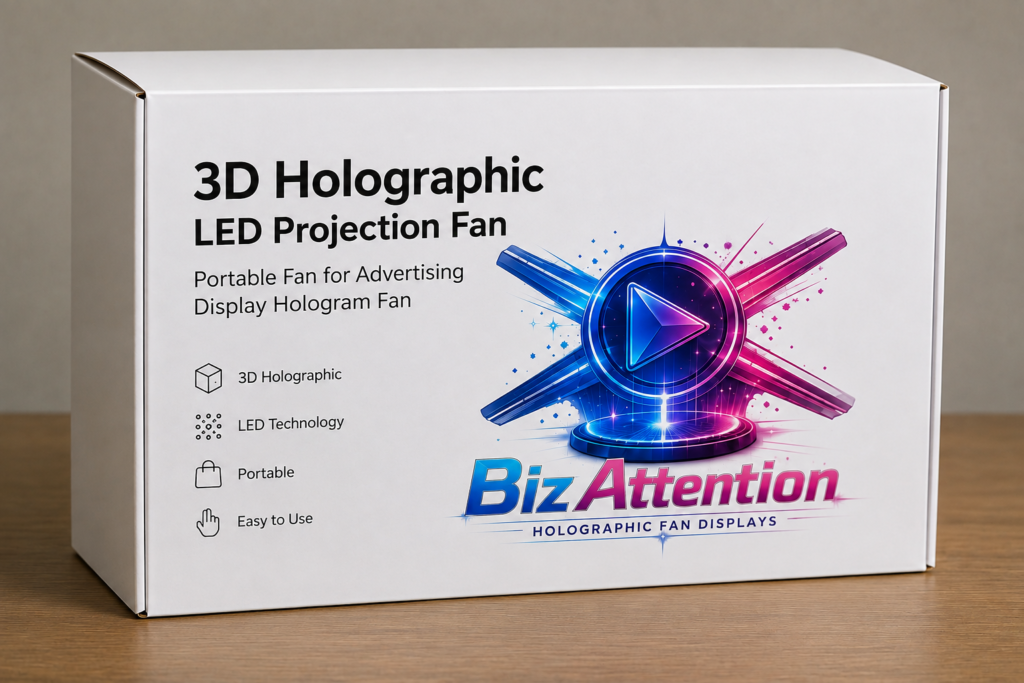
For example, holographic fan displays can create moving 3D visuals that appear to float in the air.
These displays can be used to showcase:
- Products
- Logos
- Promotions
- New arrivals
- Special offers
- 3D animations
- Product demonstrations
And, importantly, the goal isn’t simply to have a “cool display.”
The goal is attention.
Someone sees something unusual.
They look.
They slow down.
They become curious.
They move closer.
And now they’re looking at your product.
That’s the opportunity.
Because once you make products on your shelves get noticed, you have a better chance of getting customers to consider them.
Your Shelf Attention Checklist
Before you finish reading, walk through your store and choose one product you’d like to sell more of.
Then work through this checklist:
Is it easy to see?
If not, move it.
Does it stand out?
If not, create contrast.
Does the customer understand why it matters?
If not, add a short benefit-focused message.
Is it in a good location?
If not, experiment with placement.
Can you demonstrate it?
If yes, consider showing it in action.
Can you create curiosity?
Give customers a reason to look closer.
Can you add social proof?
Show genuine customer feedback or popularity.
Can you make the experience more memorable?
This is where creative displays can make a big difference.
Then watch what happens.
Don’t assume your first attempt will be perfect.
Try something.
Observe.
Adjust.
Try again.
Over time, you’ll learn what gets your customers to stop, look, and engage.
One Small Change Can Make a Difference
You don’t have to redesign your entire store tomorrow.
In fact, start small.
Pick one product.
Move it.
Clean up the area around it.
Add a simple benefit-focused message.
Give it better lighting.
Create a small feature display.
Or, if appropriate, add movement or an interactive element.
Then watch your customers.
Do they look?
Do they slow down?
Do they pick up the product?
Do they ask questions?
Those reactions can tell you a lot.
And once you know what gets attention, you can apply the same ideas to other products throughout your store.
The Bottom Line: Get Them to Look
You don’t always need more products.
You don’t always need a bigger store.
And you don’t necessarily need to spend thousands of dollars on advertising.
Sometimes, you simply need to make the products you already have easier to notice.
Give your best products the spotlight.
Create contrast.
Use better placement.
Explain the benefit.
Create curiosity.
Demonstrate products.
Rotate your displays.
Use social proof.
And, when appropriate, use movement or technology to break through the visual clutter.
Because ultimately, the process is pretty simple:
Get Attention.
Create Curiosity.
Show the Benefit.
Start the Conversation.
Make the Sale.
So, the next time you walk through your store and see a great product sitting unnoticed on a shelf, don’t immediately assume customers don’t want it.
Instead, ask yourself:
“What could I change to make products on my shelves get noticed?”
That question could lead you to a better display, a better customer experience, and potentially more sales.
And sometimes, the difference between a product that sits on the shelf and a product that flies off the shelf isn’t the product at all.
It’s whether people notice it.
Ready to Get More Attention?
At Biz Attention, we’re focused on one thing:
Helping Businesses Get Attention.
Because when customers notice your products, you have an opportunity to show them why they should care.
Make them look.
Make them curious.
Make your products memorable.
Then give them a reason to buy.
Biz Attention — Helping Businesses Get Attention.
👉 Ready to give your customers something they’ll remember? Explore Biz Attention’s holographic displays and find the right display for your business.
Click here to see our products.
















Leave a Reply