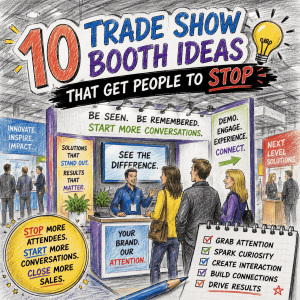
How to Stop Trade Show Traffic: 10 Ways to Get Attendees to Stop at Your Booth
Imagine spending thousands of dollars on a trade show.
You’ve paid for the booth space, shipped your products, designed the graphics, printed the brochures, trained your team, and spent hours setting everything up.
Finally, the doors open.
Attendees begin walking through the aisles.
You watch them approach your booth.
They glance over.
Then they keep walking.
And there goes another potential customer.
Unfortunately, this is one of the biggest frustrations trade show exhibitors face. Your company may have an incredible product, but if attendees don’t stop long enough to discover it, they may never know what you can do for them.
That’s why trade show marketing starts with attention.
Before you can have a conversation, demonstrate your product, collect a lead, or make a sale, you first have to get someone to stop.
The good news is that you don’t necessarily need the biggest booth at the show.
Instead, you need a booth that gives people a reason to stop.
So, let’s look at 10 practical ways to stop trade show traffic and turn passing attendees into booth visitors.
1. Give People A Reason To Stop
First and foremost, your booth needs to answer one question:
“Why should I stop here?”
Trade show attendees are constantly deciding where to spend their limited time.
As a result, they’re unlikely to stop simply because your company name is displayed on a banner.
You need to give them something more.
For example, you could offer:
- A live product demonstration
- An unusual visual display
- An interactive experience
- A product test
- A contest or giveaway
- A special trade show offer
- Something unexpected
In other words, don’t simply tell people who you are. Give them a reason to find out more.
A Simple Example
Imagine you’re selling a new piece of business technology.
Instead of displaying a sign that simply says:
“ABC TECHNOLOGY — INNOVATIVE BUSINESS SOLUTIONS”
you could display:
“SEE HOW TO SAVE 10 HOURS EVERY WEEK.”
Now you’ve given the attendee a potential benefit.
Consequently, you’ve created a reason to stop and ask, “How?”
Try It
Stand at the end of your trade show aisle and look toward your booth.
Now ask yourself:
“What would make me stop?”
If you don’t have a good answer, that’s your first opportunity for improvement.
2. Make Your Booth Visible From The Aisle
Your booth doesn’t begin at the edge of your carpet.
Instead, it begins several feet away—where attendees first notice you.
Therefore, you need to think about what people see as they approach.
Can they immediately tell what your company does?
Is there something visually interesting?
Can they see your best product?
Is your primary message easy to understand?
Furthermore, consider the height of your displays.
A sign sitting at eye level may disappear among hundreds of other signs.
On the other hand, something taller or more visually distinctive can stand out above the crowd.
A Simple Example
Imagine walking down a trade show aisle.
You see dozens of standard banners.
Then, suddenly, you notice something visually unusual rising above a booth.
Your eyes move toward it.
You slow down.
You look again.
That’s the reaction you’re trying to create.
Try It
Have someone take a photo of your booth from the aisle before the show opens.
Then, look at the picture on your phone.
What do you notice first?
If the answer is your company name, that’s fine.
However, if the answer is a visual element that makes you curious, you’re on the right track.
3. Use Movement To Break Through The Noise
Trade shows are visually overwhelming.
There are banners.
Screens.
Products.
Lights.
People.
Videos.
Displays.
Because of this, another static sign can easily disappear into the background.
However, movement can help break through that visual noise.
For example, you could use:
- Video walls
- Animated displays
- Moving product demonstrations
- Digital signage
- Interactive screens
- Holographic displays
Movement gives attendees another reason to look.
More importantly, once someone looks, you’ve created an opportunity to get them to stop.
Here’s The Important Part
You don’t need the attendee to watch your entire presentation.
You only need to get them to look.
Then, your booth staff can take over.
Try It
Look at your current booth design.
Now identify one element that could move, change, animate, or demonstrate something.
Then ask yourself how that movement could be used to create curiosity.
4. Create Curiosity
Curiosity is incredibly powerful at trade shows.
For example, think about the last time you saw something you didn’t understand immediately.
You probably wanted to get a closer look.
The same thing happens at trade shows.
Instead of displaying a sign that simply says:
“OUR NEW PRODUCT”
you could create a message such as:
“WHAT IS THAT?”
Or:
“SEE WHAT’S INSIDE.”
Or:
“YOU’VE NEVER SEEN THIS BEFORE.”
Now you’ve created an information gap.
People want to close that gap.
As a result, curiosity can turn a passing attendee into a booth visitor.
A Simple Example
A company exhibiting a new technology could display the product without immediately explaining exactly how it works.
Instead, the booth could use a simple message:
“CAN YOU GUESS HOW THIS WORKS?”
Suddenly, attendees have a reason to ask questions.
And questions create conversations.
Try It
Look at your current booth messaging.
Does it explain everything immediately?
If so, consider changing one message to create a little mystery.
After all, sometimes the best way to get someone to ask a question is to give them a reason to have one.
5. Put Your Best Product Front And Center
Another common mistake is hiding the most interesting product inside the booth.
Unfortunately, that doesn’t help people walking past.
Your best product should be visible from the aisle.
For example, if you have a product that is visually impressive, place it where attendees can see it before they enter your booth.
If possible, elevate it.
Light it.
Demonstrate it.
Or, better yet, show it doing something.
A Simple Example
Imagine you sell a new piece of technology.
Instead of placing it on a table with five other products, create a dedicated display around it.
Then:
- Highlight one important benefit
- Demonstrate how it works
- Keep the surrounding area uncluttered
- Give attendees an easy way to ask questions
As a result, the product becomes the reason people approach your booth.
Try It
Choose the one product you’d most like attendees to ask about.
Then make it the star of your booth.
6. Give Attendees Something To Do
People are much more likely to remember an experience than a sales pitch.
Therefore, whenever possible, give attendees something to do.
For example, let them:
- Try the product
- Test the technology
- Take a photo
- Participate in a demonstration
- Answer a question
- Enter a contest
- Watch something unexpected
In addition, interactive experiences can create natural conversation starters for your staff.
Instead of approaching someone with:
“Can I tell you about our company?”
your team can ask:
“Would you like to try it?”
That’s a much easier conversation to start.
A Simple Example
A software company could allow attendees to test a feature on a tablet.
A manufacturer could let visitors operate a piece of equipment.
A food company could offer a sample.
A technology company could let attendees interact with a new device.
The common denominator is simple: people aren’t just looking—they’re participating.
Try It
Ask yourself:
“What could someone actually do at my booth?”
If the answer is “nothing,” look for one simple way to make your booth interactive.
7. Give People A Reason To Come Back
Not every attendee will be ready to talk to you the first time they pass your booth.
Therefore, don’t assume that one pass means you’ve lost the opportunity.
Instead, give people a reason to remember you.
For example, you could announce:
“LIVE DEMONSTRATION AT 2 PM.”
Or:
“NEW PRODUCT REVEAL AT 3 PM.”
Or:
“TRADE SHOW SPECIAL — TODAY ONLY.”
This creates anticipation.
Furthermore, it gives your staff another opportunity to reconnect with people later.
A person who wasn’t ready to stop at 10 AM may be very interested at 2 PM.
Try It
Schedule something worth coming back for.
Then make sure your booth clearly communicates what is happening, when it is happening, and why attendees should return.
8. Keep Your Message Simple
One of the biggest mistakes exhibitors make is trying to say too much.
- They put their company name on the banner.
- Then their slogan.
- Then their product categories.
- Then their services.
- Then their website.
- Then three paragraphs of text.
Unfortunately, people walking through a trade show don’t have time to read all of that.
Instead, make your primary message simple.
Your attendee should understand three things quickly:
What do you offer?
Why should I care?
What should I do next?
A Simple Example
Instead of:
“ABC Industries provides innovative technology solutions designed to optimize operational efficiency across multiple industries.”
Try:
“Cut Your Processing Time.”
Then:
“See How It Works.”
Now you’ve presented a benefit and a next step.
As a result, the attendee has a reason to stop and ask how.
Try It
Take the main message from your booth and cut it in half.
Then cut it in half again.
Keep only the information that helps someone decide whether they should stop.
9. Train Your Booth Staff To Stop Traffic
Even the best booth in the building can fail if the people working it don’t know how to engage attendees.
For example, staff members standing behind a table looking at their phones can make your booth feel closed.
Instead, your team should look approachable, alert, and interested in the people walking by.
However, there’s another important point:
Don’t immediately launch into a sales pitch.
Instead, start with a simple question.
For example:
“What brought you to the show?”
Or:
“What are you looking for this year?”
Or:
“Have you seen anything interesting so far?”
These questions feel like conversations rather than sales pitches.
Consequently, attendees may feel more comfortable stopping and talking.
A Simple Example
An attendee slows down and looks at your display.
Instead of immediately saying:
“Let me tell you about our product.”
a team member could say:
“Is this something you’ve seen before?”
The attendee might say yes.
Or no.
Either way, you’ve started a conversation.
Try It
Before the show opens, practice three or four natural conversation starters with your team.
That way, everyone knows how to begin a conversation without sounding scripted.
10. Give Attendees Something They Haven’t Seen Before
Finally, sometimes the best way to stop trade show traffic is simply to be different.
Think about it.
If every booth has:
- A banner
- A table
- Product brochures
- Business cards
- A television screen
then your booth can easily look like every other booth.
Therefore, something unexpected can create a powerful advantage.
This is where attention-grabbing technology can become especially useful.
For example, holographic displays can create the appearance of products, logos, animations, or other visual content floating in the air.
Instead of simply showing a product on a table, you can create a visual experience that makes people wonder:
“How are they doing that?”
And that’s exactly the reaction you want.
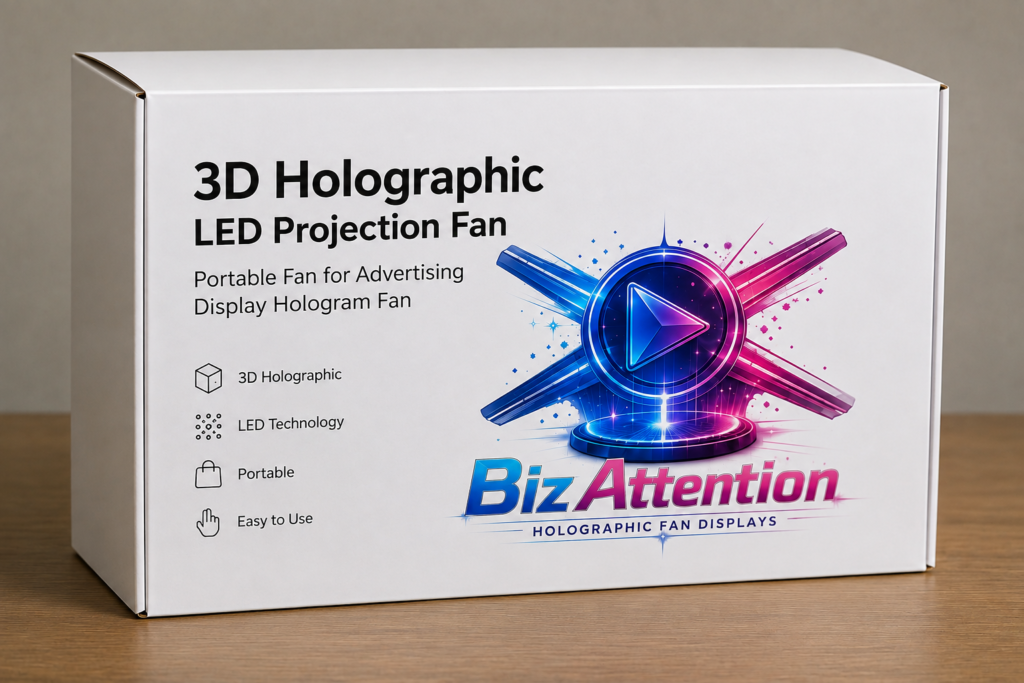
At Biz Attention, we specialize in holographic fan displays designed to help businesses create attention-grabbing visual experiences.
These displays can be used to showcase:
- Products
- Logos
- Brand messages
- 3D animations
- Product demonstrations
- New releases
- Special promotions
However, the display itself isn’t the goal.
The goal is to create the moment that makes someone stop.
Once they stop, your team has the opportunity to start a conversation.
Once you have a conversation, you can discover whether they’re a potential customer.
Ultimately, that’s what trade show marketing is about:
Attention → Conversation → Connection → Opportunity
Try It
Look at your current booth and ask:
“What will attendees see here that they won’t see in the next booth?”
If you can’t answer that question, you have an opportunity to make your booth more memorable.
The Bottom Line: Stop The Traffic Before You Sell
A successful trade show booth isn’t necessarily the biggest booth.
It isn’t necessarily the most expensive booth.
And it certainly isn’t the booth with the most brochures.
Instead, it’s the booth that gives the right people a reason to stop.
Think about what happens when you get the sequence right:
First, they notice you.
Then, they become curious.
Next, they stop.
After that, your team starts a conversation.
Finally, that conversation can become a lead, a relationship, or even a sale.
That’s why getting booth traffic matters so much.
If 1,000 people walk past your booth but only a handful stop, you’ve had very few opportunities to connect.
However, if you can give significantly more of those people a reason to stop, you’ve created more opportunities without necessarily increasing the number of people attending the show.
Your Trade Show Attention Checklist
Before your next show, ask yourself:
□ Can attendees understand what we do within a few seconds?
□ Is there something they can see from the aisle that makes them curious?
□ Does our booth have movement or something visually different?
□ Is our best product clearly visible?
□ Do attendees have something to interact with?
□ Is our message simple and benefit-focused?
□ Does our staff know how to start natural conversations?
□ Do we have a reason for attendees to come back?
□ Does our booth look different from the booths around us?
□ Do we have something people will remember after they leave?
If you answered “no” to several of these questions, don’t worry.
That’s actually good news.
It means you have opportunities to improve your booth before the next show.
And you don’t have to change everything at once.
Start with one thing.
Make your booth easier to notice.
Then create curiosity.
Then give people a reason to stop.
Small improvements in attention can create much bigger opportunities for conversation.
Want More People To Stop At Your Trade Show Booth?
At Biz Attention, our goal is simple:
Helping Businesses Get Attention.
Our holographic displays are designed to help exhibitors create visual experiences that make people look twice, stop, and become curious about what’s happening at your booth.
Because at a busy trade show, you don’t want to be another booth people walk past.
You want to be the booth they remember.
If you’re planning your next trade show, take a look at our trade show display solutions and see how you can create a more attention-grabbing booth.
See Trade Show Display Ideas → bizattention.com/ts
Get attention. Start conversations. Create opportunities.
Biz Attention — Helping Businesses Get Attention.
👉 Ready to give your customers something they’ll remember? Explore Biz Attention’s holographic displays and find the right display for your business.
Click here to see our products.










Leave a Reply